A result with an attribution problem
The hair trial filed under GHK-Cu
A positive result, a small trial and a second active ingredient. The part that travels least well is the identity of the treatment.
Stations
GHK brought company
The 2016 human hair-growth trial tested a complex of 5-aminolevulinic acid and glycyl-histidyl-lysine peptide. The latter is GHK. The study did not isolate the effect of pure GHK-Cu.
It followed 45 men with androgenetic alopecia—male-pattern hair loss, classified as Norwood-Hamilton II–V—for six months. Hair counts increased by 52.6 with the 100 milligrams per milliliter study formulation and by 71.5 with the 50 milligrams per milliliter formulation, compared with 9.6 for placebo. Both active groups differed significantly from placebo, and no adverse events were reported in any group.
I’m glad there is a controlled human experiment to discuss. But “a GHK-containing combination increased hair counts” and “GHK-Cu regrows hair” do not describe the same experiment. The first sentence earns its place in the record; the second needs a trial of its own.
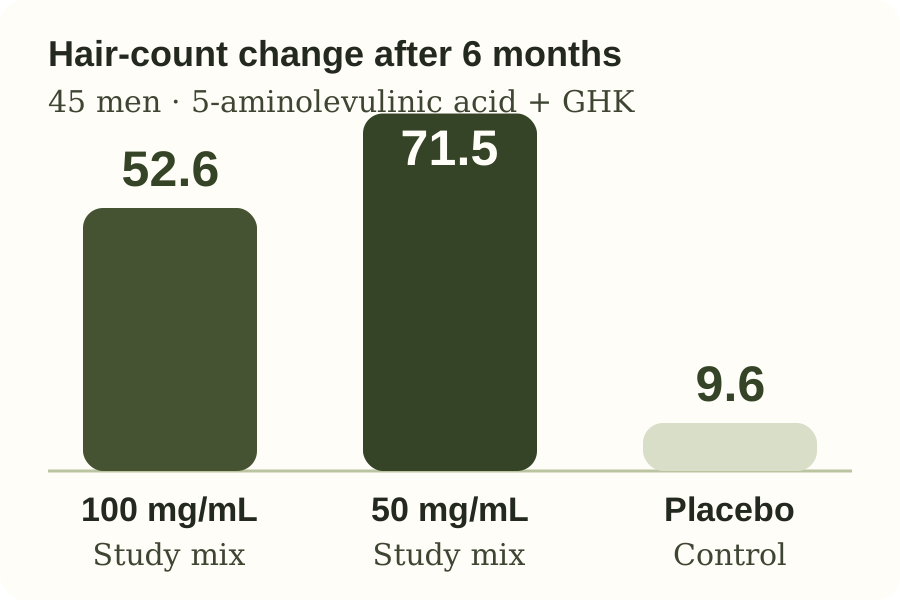
The smaller concentration had the larger count
The lower-concentration group had the larger numerical increase. The trial reports the difference but does not settle why the groups came out in that order. The small sample and combination treatment leave the choice of concentration unresolved.
I like this awkward result because it resists the usual escalation story. The numbers did not climb neatly with concentration. They also cannot say how much of the effect belonged to GHK, how much belonged to its partner, or how either would perform alone.
Six months was the measured course of the trial. The shorter timelines repeated in search answers do not become trial endpoints through repetition. Likewise, the absence of reported adverse events applies to this group over that study period; safety over years of use or across every type of hair loss remains unestablished.
A possible mechanism is still waiting for its own test
The tissue-remodeling review describes blood-vessel growth and support for surrounding tissue as part of the copper-peptide rationale. Work with human cells in GHK-modified gels offers another laboratory connection to blood-vessel growth signals. Neither result identifies what caused the extra hairs in the human combination trial.
The literature does not establish GHK-Cu as a DHT blocker; its proposed hair rationale involves follicle support and blood-vessel growth. The human trial did not demonstrate a hormone-blocking action. There is no reason to turn that proposal into a claim that it complements another hair treatment.
I’m interested in a future comparison that separates the ingredients and measures a sustained hair outcome. Until then, the combination result remains the useful human finding. The missing experiment is just as specific: GHK-Cu on its own.